
NITI Aayog member Arvind Virmani on Monday said India is set to become the fourth largest economy in the world by the end of 2025, an assertion which came days after NITI CEO BVR Subrahmanyam claimed India has already overtaken Japan to reach that spot. The International Monetary Fund (IMF), in its World Economic Outlook (WEO) report released in April had said that India is expected to be the fourth largest economy in the world with a GDP of $4.19 trillion in 2025, ahead of Japan.

India's economic growth forecast for 2025 has been revised downward to 6.3 per cent, and despite a projected moderation, the country remains one of the fastest-growing large economies, supported by resilient consumption and government spending, the United Nations has said.

Reflecting subdued global economic growth, India's outward foreign direct investment (FDI) fell by 33.3 per cent sequentially to $1.21 billion in August, compared to over $1.82 billion in July.
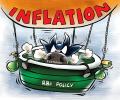
The Reserve Bank of India on Friday retained its projection for retail inflation at 4.5 per cent for the current fiscal assuming a normal monsoon, while emphasising that uncertainties related to food price outlook warrant a close monitoring. Consumer Price Index (CPI)-based retail inflation has been projected at 4.5 per cent with quarter-wise projections at 4.9 per cent in Q1 (April-June), 3.8 per cent in Q2, 4.6 per cent in Q3, and 4.5 per cent in Q4.

'If you look at the order books of capital equipment companies or money deployed on the ground, there is forward movement in terms of actual investment by the private sector.'

Despite a strong 7.8 per cent growth in the first quarter, the Indian economy is expected to grow at 6.5 per cent in the current financial year as the impact of US tariffs on Indian exports will reduce prospects, particularly in the second half, ADB said on Tuesday.

Moody's Ratings on Tuesday cut India's GDP growth projections for 2025 to 6.3 per cent, from 6.5 per cent, saying economies globally will see a slowdown on account of heightened US policy uncertainty and trade restrictions.

Led by a sharper-than-expected deceleration in industrial activity, economic growth in India slowed more than anticipated and is projected to remain at 6.5 per cent till 2026, the International Monetary Fund said on Friday. "Growth in India slowed more than expected, led by a sharper-than-expected deceleration in industrial activity," the IMF said in its latest update of the World Economic Outlook, according to which the global economy is holding steady. In 2023, India's growth rate was 8.2 per cent, which dropped to 6.5 per cent in 2024.
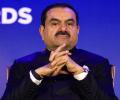
The Adani group, which operates across multiple infrastructure sectors, with 12 listed entities in India and a combined market capitalisation of about $200 billion, remains "anchored by strong assets and robust cash flows", according to a Bank of America (BofA) report.

India's equity markets may have expanded rapidly, but initial public offerings (IPOs) are increasingly becoming exit vehicles for early investors rather than as engines for raising long-term capital, a shift that undermines the spirit of public markets, Chief Economic Advisor V Anantha Nageswaran warned on Monday at a CII event.
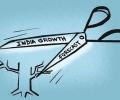
Moody's on Friday slashed India's GDP growth projections for 2022 to 7 per cent from 7.7 per cent earlier as the global slowdown and rising domestic interest rates will dampen economic momentum. This is the second time that Moody's Investors Service has cut India's growth estimates. In September, it had cut projections for the current year to 7.7 per cent from 8.8 per cent estimated in May. "For India, the 2022 real GDP growth projections have been lowered to 7 per cent from 7.7 per cent.

Strategic affairs experts express concern over US President Donald Trump's tariffs on India, his 'bullying tactics,' and increasing attempts to hyphenate New Delhi with Islamabad, signaling a potential shift in the bilateral relationship.

Indian growth in the rest of this fiscal year and next will be propelled by robust domestic consumption as consumer confidence improves, and by investment, including large increases in government capital expenditure, according to the Asian Development Outlook September 2023. "As slowing exports could foment headwinds for the economy, and erratic rainfall patterns are likely to undermine agricultural output, the growth forecast for FY2023 is revised down marginally to 6.3 per cent," ADB said.

'GST reduction will help larger and high-end cars too.'

India's extreme poverty rate declined sharply to 5.3 per cent over a decade from 27.1 per cent in 2011-12 even as the World Bank revised upwards its threshold poverty line to $3 per day.

Sanjay Malhotra has made structural changes to banking regulation to bring down costs and increase efficiency. Plus, he kicked off a benign interest regime. But there are challenges ahead.

India will be the world's third-largest economy by 2028 as it becomes the world's most sought-after consumer market and gains share in global output, driven by macro stability influenced policy and better infrastructure, Morgan Stanley said. From a $3.5 trillion economy in 2023, the Indian economy is projected to expand to $4.7 trillion in 2026, which will make it the fourth largest in the world behind the US, China and Germany.

The Indian pharmaceutical industry is likely to benefit from a major wave of patent expiries in the US, as small-molecule drugs worth $63.7 billion are expected to go off-patent between 2025-29, a 65 per cent rise over the previous five years, according to a report by Antique stock broking limited.

S&P Global Ratings on Thursday said the hostilities between India and Pakistan heighten risks to the credit metrics of both countries, and any escalation in clashes would put downward pressure on sovereign credit support.

The Reserve Bank on Wednesday projected retail inflation to ease to 5.3 per cent in next fiscal from 6.5 per cent this year on assumptions of lower imported inflation, even though core inflation remains sticky. The RBI's inflation outlook for current fiscal has improved from 6.8 per cent projected earlier, to 6.5 per cent, on the back of steeper than expected decline in vegetable prices and Indian basket of crude at $95 a barrel. "Looking ahead, while inflation is expected to moderate in 2023-24, it is likely to rule above the 4 per cent target.

Geopolitical tensions, trade policy uncertainties, volatility in international commodity prices and financial market uncertainties pose considerable risks to India's economic growth in the coming year, the finance ministry cautioned on Wednesday. "Global trade continues to be affected by uncertainty in the policy environment... tariff-related developments in multiple countries have heightened trade-related risks, affecting investment and trade flows globally.

India's economy is projected to grow between 6.3 per cent and 6.8 per cent in FY26, according to the Economic Survey 2024-25, tabled in Parliament on Friday. The survey highlights that the country's economic fundamentals remain strong, supported by a stable external account, fiscal consolidation, and private consumption. It noted that the government plans to strengthen long-term industrial growth by focusing on research and development (R&D), micro, small, and medium enterprises (MSMEs), and capital goods.

It was August 2007. Tata Steel was turning 100. Jamshedpur, its hometown, had an air of celebration. The line-up for the special event included the launch of Air Deccan's commercial flight connecting Kolkata and Jamshedpur, and release of Russi Lala's new book, Romance of Tata Steel. There was also the screening of The Spirit of Steel, a 20-minute documentary directed by Zafar Hai showcasing Tata Steel's legacy, and a corporate anthem penned by Javed Akhtar and composed by Shankar, Ehsaan and Loy.
The Asian Development Bank (ADB) on Wednesday lowered India's growth forecast for FY26 to 6.5 per cent from 6.7 per cent on account of trade uncertainty and higher US tariffs that are expected to impact exports and investment. Despite the downward revision from the April 2025 Asian Development Outlook (ADO), India remains one of the fastest-growing major economies in the world.

"The outlook for exports in 2008-09 may not be as bright as in the past few years with lower projections in world GDP and world imports and exchange rate developments," according to the pre-Budget Economic Survey tabled in Parliament.

India's Foreign Secretary Vikram Misri has underscored the importance of not equating the victims and perpetrators of terror attacks, highlighting the need for global unity in combating terrorism. Speaking at Raisina Tokyo 2025, Misri expressed appreciation for Japan's support following the recent terror attack in Pahalgam, India. He also cautioned against the trend of some Western countries hyphenating India and Pakistan in the context of their recent military confrontation. Misri further outlined India's economic aspirations and its commitment to becoming a factor of stability in a turbulent world.

The International Monetary Fund (IMF) on Tuesday slashed India's growth forecast for 2022-23 (FY23) by 80 basis points to 7.4 per cent, citing less favourable external conditions and rapid policy tightening by the central bank. In its update to the April World Economic Outlook, the IMF said that though a global recession in 2022 was ruled out with a growth estimate of 3.2 per cent, the balance of risks was squarely to the downside, driven by a wide range of factors that could adversely affect the global economic performance. "The risk of recession is particularly prominent in 2023, when in several economies growth is expected to bottom out, household savings accumulated during the pandemic will have declined, and even small shocks could cause economies to stall.

The global economy is projected to expand by 4.2 per cent this year, but rising oil and commodity prices and European debt crisis could hurt the overall recovery, according to Paris-based think-tank OECD.
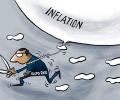
'As the Budget has taken some measures to spur growth, similar action from the MPC may be expected.'
S&P Global Ratings on Tuesday cut India's GDP growth projections to 6.5 per cent for the next fiscal as it expects that economies in the APAC region will feel the strain of rising US tariffs and pushback on globalisation. In its Economic Outlook for Asia-Pacific (APAC), S&P said despite these external strains, it expects domestic demand momentum to remain solid in most emerging-market economies.

The Survey is authored by Chief Economic Advisor V Anantha Nageswaran and his team.

India witnessed a 12 per cent year-on-year (YoY) jump in total household wealth last year, at $14,225 billion, according to the Global Wealth Report 2022 by Credit Suisse. The report also forecasts the number of millionaires in the country to more than double from 796,000 in 2021 to 1.6 million in 2026. According to the report, which is based on data for the wealth holdings of 5.3 billion adults across nearly 200 countries, global household wealth rose 9.8 per cent in 2021 to $463.6 trillion, driven by widespread gains in share prices and a favourable environment created by central bank policies in 2020 to lower interest rates but at the cost of inflationary pressure.

India is likely to be the fastest-growing Asian economy in 2022-23, according to analysts at Morgan Stanley. They expect India's gross domestic product growth to average 7 per cent during this period - the strongest among the largest economies - and contributing 28 per cent and 22 per cent to Asian and global growth, respectively. The Indian economy, they said, is set for its best run in over a decade as pent-up demand is unleashed.
The International Monetary Fund (IMF) on Tuesday lowered India's economic growth projection for the current fiscal to 5.9 per cent from 6.1 per cent earlier. Yet India will continue to be the fastest-growing economy in the world. In its annual World Economic Outlook, IMF also lowered the forecast for 2024-25 fiscal (April 2024 to March 2025) to 6.3 per cent from the 6.8 per cent it had predicted in January this year. The growth rate of 5.9 per cent in the 2023-24 fiscal compares to an estimated 6.8 per cent in the previous year.
Moody's Ratings on Wednesday said India's economic growth will exceed 6.5 per cent in the next fiscal, up from 6.3 per cent this year, on higher government capex and consumption boost from tax cuts and interest rate reduction. Projecting a stable outlook for the banking sector, Moody's said although the operating environment of Indian banks will remain favourable in the next fiscal, their asset quality will deteriorate moderately after substantial improvements in recent years, with some stress in unsecured retail loans, microfinance loans and small business loans.

Moody's Investors Service on Wednesday raised India's economic growth estimate for 2023 to 5.5 per cent from 4.8 per cent pegged earlier, on the back of a sharp increase in capital expenditure in the Budget and a resilient economic momentum. It however revised downwards India's growth estimate for 2022 to 6.8 per cent from 7 per cent pegged in November last year. In its February update to Global Macro Outlook 2023-24, Moody's raised the baseline 2023 real growth projections "meaningfully" for several G20 economies, including the US, Canada, the Euro area, India, Russia, Mexico, and Turkiye, accounting for a stronger end to 2022.

'If the US stagnates and falls into a recession, the dollar will weaken, oil prices will also dip. This augurs well for India.'
The RBI on Wednesday slashed key interest rate by 25 basis points, for the second time in a row, to support a shuttering economy hit by reciprocal tariffs imposed by the US. Following the rate cut, the key policy rate eased to 6 per cent providing relief to home, auto and corporate loan borrowers.
The Indian economy is recovering from the slowdown in momentum witnessed in the September quarter, driven by strong festival activity and a sustained upswing in rural demand, according to a Reserve Bank of India (RBI) bulletin released on Tuesday. An article on the 'State of the Economy' in the December bulletin noted that the global economy continues to exhibit resilience with steady growth and moderating inflation.

S&P Global Ratings on Tuesday said the Indian economy is set for "resilient growth" in 2025 and projected inflation pressure to recede which will lead to "modest" easing of the monetary policy by the RBI. In its India outlook for 2025, S&P also retained India's growth forecast for current fiscal at 6.8 per cent, followed by 6.9 per cent growth in 2025-26.
